Vascular-Immune Interactions Across Development and Aging
Our group investigates how vascular-immune crosstalk is established during development and dynamically remodeled with aging, with a particular focus on macrophage-niche interactions and their roles in regulating tissue architecture, stem cell niches and repair.
Continuous immune cell production relies on functional hematopoietic stem cells (HSCs) which emerge during early embryogenesis. Before HSC emergence, distinct embryonic progenitors rapidly differentiate into immune cells that can persist into adulthood, creating a heterogeneous immune system with diverse developmental origins.
Tissue-resident macrophages are immune sentinels, where their function is linked to their origin. Embryo-derived macrophages, rather than the adult counterparts, are required for normal number of mature immune cells and progenitors. For example, embryo-derived red pulp macrophages sustain dendritic cells in the spleen, and bone marrow resident macrophages of embryonic origin establish HSC pool perinatally, influencing the entire hematopoietic hierarchy.
As a lab, we aim to understand how ontogenetically distinct macrophages shape tissue aging and disease. We focus on their roles across the cardio vasculature, bone marrow and blood, and how these systems regulate and communicate one another during development and aging.

Our group investigates how vascular-immune crosstalk is established during development and dynamically remodeled with aging, with a particular focus on macrophage-niche interactions and their roles in regulating tissue architecture, stem cell niches and repair.
Continuous immune cell production depends on functional hematopoietic stem cells (HSCs), which emerge during early embryogenesis. Before HSC emergence, distinct embryonic progenitors rapidly differentiate into immune cells, that can persist into adulthood, creating a heterogeneous immune system with diverse developmental origins.
Tissue-resident macrophages are immune sentinels, whose function is tightly linked to their origin. Embryo-derived macrophages, rather than adult counterparts, are essential to maintain normal numbers of mature immune cells and progenitors. For example, embryo-derived red pulp macrophages sustain dendritic cells in the spleen, and bone marrow macrophages of embryonic origin establish the HSC pool early in life, influencing the entire hematopoietic hierarchy.
Macrophages are not the only immune cells of embryonic origin that reside in the bone. Osteoclasts, the multinucleated immune cells responsible for creating space for bone marrow hematopoiesis, share an origin with embryonic macrophages. Remarkably, their maintenance in vivo, depends on fusion with HSC-derived circulating monocytes. Taking advantage of this mechanism, we showed that functional nuclei from blood monocytes can improve the defective osteoclast function, suggesting a potential alternative treatment strategy for autosomal recessive osteopetrosis patients. Currently, we are exploring whether this mechanism is conserved across species. A small hint is at the bottom of the webpage,
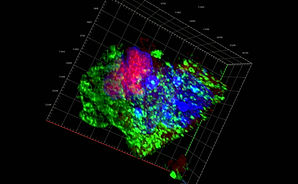
spinning: yes, this is an osteoclast, and yes, it contains a human nucleus integrated in a mouse cell!
Finally the vasculature links all tissues, guiding immune cell formation, communication and aging. We aim to understand how macrophage origin influences cardiovascular aging and repair, and how vascular origin shapes the generation of mature and progenitor immune cells during development. Our work explores how the vasculature mediates communication between HSCs, mature immune cells, and their niches throughout life.